 Save
Save There's a particular Vienna café where I watched a chef work a piece of veal with practiced, rhythmic strokes of her mallet, transforming it into something impossibly thin and tender. She moved with such ease that it seemed less like cooking and more like a conversation she'd been having for decades. That moment stuck with me, and when I finally made Wiener Schnitzel at home, I understood why this dish has remained unchanged in Austria for generations—because it doesn't need to be improved, only respected.
My neighbor once asked what smelled so good wafting over the fence—I was frying schnitzels on a quiet Saturday afternoon. She came over, took one bite with lemon and parsley, and immediately asked for the recipe. I handed her the whole packet of veal from my butcher instead. That's the kind of dish that makes people want to learn to cook.
Ingredients
- Veal cutlets (4 pieces, about 150g each): The foundation—ask your butcher to cut them from the leg or loin, and they'll often pound them for you, though doing it yourself gives you better control over thickness and an oddly meditative moment before cooking.
- All-purpose flour (100g): This isn't just a coating; it creates a barrier that helps the egg wash adhere properly to create that essential crispy shell.
- Eggs (2 large) and milk (4 tbsp): Together they form a binder that's richer and more forgiving than water alone, helping the breadcrumbs cling evenly without slipping off in the pan.
- Fine dry breadcrumbs (150g): Use panko if you want extra crunch, or finely grated stale bread if you want to honor the older Austrian method—the finer the crumb, the more delicate and crispy your crust will be.
- Clarified butter or neutral oil (250ml): This quantity matters because schnitzels need to swim in fat, not just cook in it; clarified butter carries a subtle richness that regular butter can't, since the milk solids have been removed.
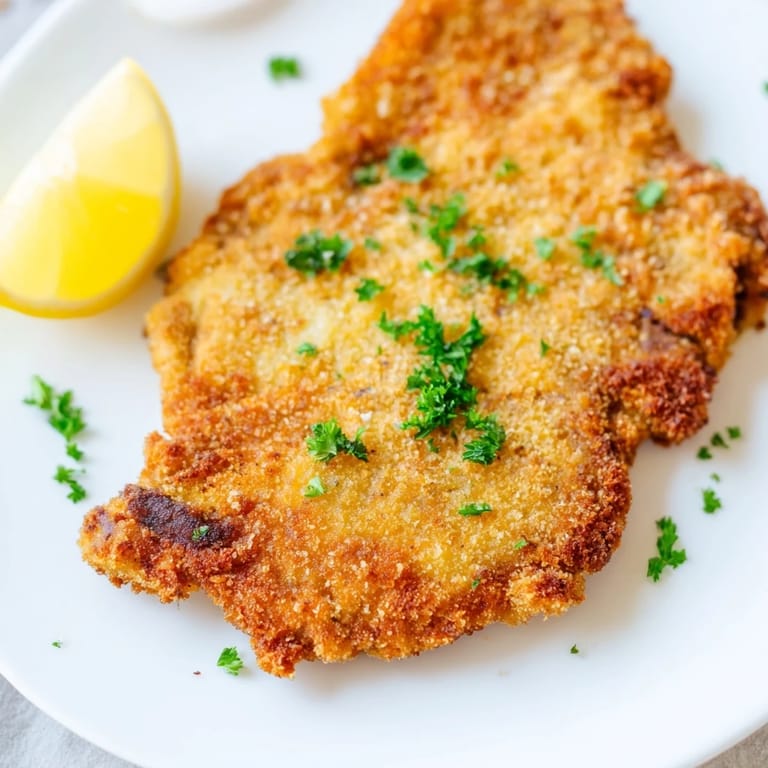
- Lemon (1 whole, cut into wedges) and fresh parsley (2 tbsp, chopped): These aren't garnishes—the brightness of lemon cuts through the richness and parsley adds a visual and textural contrast that completes the dish.
Tired of Takeout? 🥡
Get 10 meals you can make faster than delivery arrives. Seriously.
One email. No spam. Unsubscribe anytime.
Instructions
- Pound the veal until paper-thin:
- Place each cutlet between plastic wrap and use steady, gentle strokes with your mallet—you're persuading the meat to relax and spread, not battering it into submission. Aim for an even 1/4 inch thickness so it cooks uniformly, then pat dry with paper towels and season lightly with salt and pepper.
- Arrange your breading station:
- Lay out three shallow dishes: flour in the first, beaten eggs mixed with milk in the second, and breadcrumbs in the third. This assembly-line approach prevents cross-contamination and keeps your hands relatively clean.
- Coat each cutlet with methodical care:
- Dredge in flour first and shake off the excess—you want a thin, even layer, not a caked-on skin. Dip into egg mixture until fully coated, then press lightly into breadcrumbs without actually pressing down, as loose crumbs fry up crispier than ones you've crushed into the meat.
- Fry until golden and shimmering:
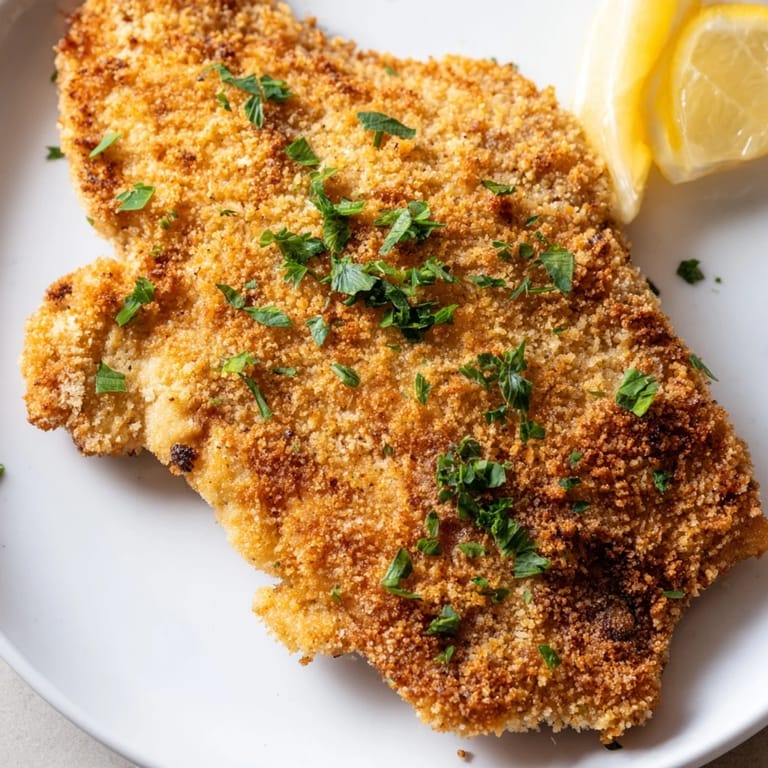
- Heat your butter or oil until it shimmers visibly across the pan, then place one or two schnitzels in, depending on size. Fry for 2 to 3 minutes per side, then tilt the pan and baste the top with the hot fat using a spoon—this is the move that ensures even, deep golden color.
- Rest and serve immediately:
- Transfer to paper towels to drain for just a minute, then plate while still hot with lemon wedges alongside and a sprinkle of parsley if you have it. The crust softens as it sits, so timing matters here.
 Save
Save I once served schnitzel to my mother-in-law, and she ate it silently at first, then set down her fork and said it reminded her of her childhood in Salzburg. That's when I realized this dish carries something larger than technique—it's a edible bridge across time and place.
The Silence of Simplicity
There's a peculiar magic in dishes that demand so little yet deliver so much. Wiener Schnitzel has no sauce to hide behind, no complex reduction to proof your skills—it's just veal, breadcrumbs, and fat, asking you to get the fundamentals right. That's harder than it sounds, and that's why it matters. You'll find yourself thinking about each step differently each time, noticing things you missed before, and that's the sign of a dish worth cooking again and again.
Serving and Sides
Traditionally, schnitzel is served with warm potato salad that's dressed while still hot, or a cool, vinegary cucumber salad that balances the richness of the fried meat. Some versions come with lingonberry jam on the side—a sweet-tart note that cuts through the fat in an unexpected way. The plate is simple because the schnitzel deserves the attention.
Timing and Technique Notes
The actual cooking takes minutes, but the rhythm of preparation matters as much as the technique itself. When you pound the veal, you're not just tenderizing—you're entering a conversation with the ingredient, learning its resistance and give. The breading station should be set before you touch the meat, and the fat should be perfectly hot when you slide the first cutlet in. These small adjustments turn a good schnitzel into one you'll remember.
- Pound gently and evenly, checking thickness as you go rather than aiming for a specific number of strikes.
- If your breadcrumbs are store-bought, consider toasting them briefly in a dry pan to deepen their color and flavor.
- Clarified butter is worth seeking out at specialty shops or learning to make at home—the difference in flavor is subtle but real.
 Save
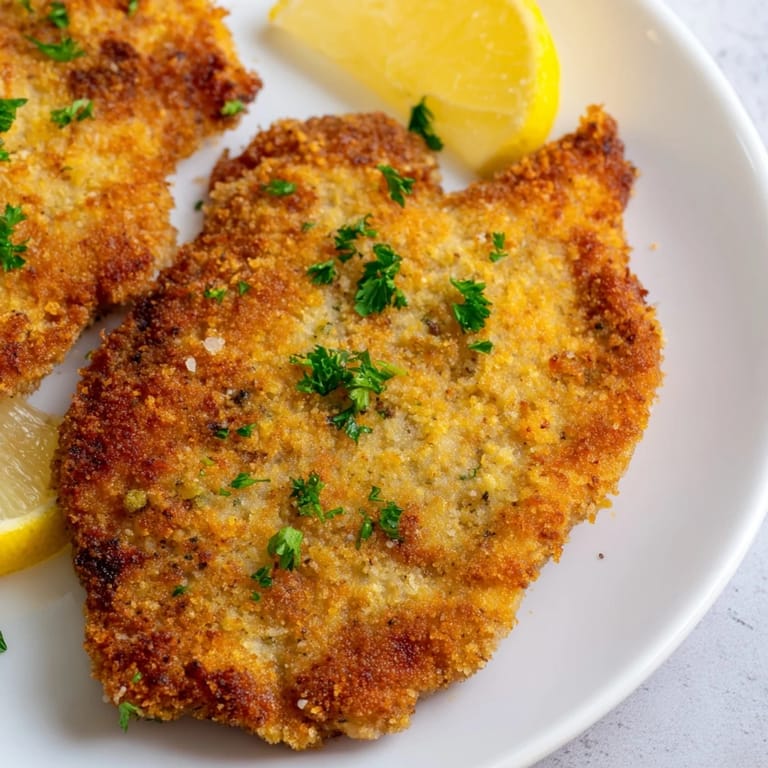
Save Wiener Schnitzel asks you to slow down and pay attention, and in return it gives you a perfect, crispy, golden memory on a plate. Make it once and you'll understand why Vienna never needed to change it.
Kitchen Questions
- → What type of meat is used for authentic Wiener Schnitzel?
Traditionally, veal cutlets are used, pounded thin to ensure tenderness and quick cooking.
- → How do you achieve a crispy crust without pressing breadcrumbs into meat?
Coat the cutlets lightly and loosely with breadcrumbs, avoiding pressing to maintain a crunchy texture after frying.
- → What cooking fat is best for frying Wiener Schnitzel?
Clarified butter is preferred for richness and flavor, but neutral oils with a high smoke point work well for crisp results.
- → Why is it important not to overcrowd the pan during frying?
Overcrowding lowers the oil temperature, resulting in soggy crusts rather than crisp, evenly browned cutlets.
- → What are traditional accompaniments for Wiener Schnitzel?
It’s often served with potato salad, cucumber salad, or lingonberry jam to balance the rich, fried cutlets.